The End of the AI Flat-Rate Era:
What Enterprises Must Budget for, under the Token-Based Pricing regime
Back to All
Insights

The era of predictable AI spend is over, and most enterprise finance teams may not realize it yet. Between November 2025 and June 2026, every major AI vendor rewired how they charge for usage. Anthropic, OpenAI, Microsoft, and Google each migrated enterprise contracts from flat per-seat fees to consumption-based token pricing. The headline rates look cheap. The bills are not. A conservative estimate indicates that a typical Fortune 500 would spend more than $30M in annual AI cost. Token consumption is growing at roughly 75% per year, driven by AI agents that consume 30 to 60 times more tokens per task than the chat tools that preceded them. One healthcare enterprise consumed one trillion tokens over six months before its finance team understood what was driving the charges. Uber exhausted its full-year AI budget by April. These are not edge cases. They are the leading signs of a major shift.
The risk is not that AI is expensive. The risk is that it is invisible. Token spend sits outside traditional procurement frameworks, scales with engineering decisions made by people with limited budget visibility, and arrives as a surprise on an invoice that nobody modeled. This paper examines the vendor pricing shifts driving this change, quantifies the cost exposure for a typical Fortune 500 company across three scenarios, and gives the CFOs and CIOs a practical framework to instrument, govern, and negotiate AI spend before consumption outpaces budget.

1. The Pricing Shift: What Each Vendor Announced
1.1 Anthropic: From Seat Fees to Consumption Commitments
The most consequential change in the enterprise AI market came from Anthropic in November 2025, though most customers only learned of it at contract renewal. Anthropic dismantled its legacy Enterprise plan, which bundled “enough usage for a typical workday” into a flat per-seat fee ranging from $40 to $200/user depending on contract terms— and replaced it with a hybrid model: $20/seat/month for Claude.ai access, plus separately metered API token consumption for all actual AI work. Anthropic also eliminated the 10-15% API volume discounts that previously applied to larger enterprise accounts. Customers must now commit to a monthly consumption level based on Anthropic’s own usage estimate, and pay that committed amount whether or not actual usage reaches it. Claude Code was simultaneously launched as a developer-focused tier at $20/user/month, also with consumption-based token billing layered on top.
Current API rates for Claude models are as follows:

Under the old model, a 30,000-employee knowledge workforce on Claude Enterprise cost roughly $14M to $72M annually in seat fees with no variable overage. Under the new structure, the seat component drops to approximately $7.2M — but every prompt, document summary, and agent task now consumes tokens billed separately at Anthropic’s API rates: $5.00/$25.00 per million tokens for Opus 4.8 (flagship), $3.00/$15.00 for Sonnet 4.6 (balanced), and $1.00/$5.00 for Haiku 4.5 (economy). Anthropic’s annualized revenue surged from $9B at end-2025 to $30B by April 2026 — confirming that consumption pricing unlocks far more spend per customer than seats ever did. More than 1,000 enterprise customers now spend over $1M annually, with that cohort driving the overwhelming majority of token-based revenue.
1.2 OpenAI: Token Pricing Across the Enterprise Portfolio
OpenAI made a parallel move in April 2026, shifting Codex from per-message to per-token pricing for all ChatGPT Enterprise plans. The current flagship, GPT-5.5, is priced at $5.00 input / $30.00 output per million tokens — the highest output rate of any mainstream frontier model. ChatGPT Business and Enterprise seat fees remain ($20–$30/user/month), but heavy agentic usage, Codex workflows, and API integrations are now entirely consumption-billed. OpenAI is also weighing significant further token price reductions as a competitive response to Anthropic, though any cuts will be moderated by the economics of both companies’ IPO considerations in mid-2026. Sam Altman has publicly acknowledged that AI costs have become “a huge issue” for corporate clients, and that OpenAI would find ways to deliver more value for less money.
The broader OpenAI portfolio spans nearly three orders of magnitude in price: from GPT-4.1 Nano at $0.10/$0.40 per million tokens at the economy end, to GPT-5.4 Pro at $60.00/$270.00 at the premium extreme. The strategic risk for enterprise CIOs is model proliferation: the median business now uses 9 AI models, the average is 16.5, and organizations using 26 or more models spend a median of $26,562/month. This is overwhelmingly driven by unnecessary routing to premium models for tasks that economy tiers could handle adequately.


1.3 Microsoft / GitHub Copilot: The Developer Cost Shock
On June 1, 2026, GitHub Copilot formally completed its transition to usage-based billing for all plans, replacing the previous “Premium Request Unit” model with GitHub AI Credits (1 credit = $0.01 USD). Copilot Business ($19/user/month) and Copilot Enterprise ($39/user/month) seat prices are unchanged, but both plans now include only a fixed AI Credit allotment; usage above that baseline is billed at published per-token API rates specific to the model consumed.
The developer reaction has been swift. One developer reported their projected monthly Copilot cost rising from €67 to €966 under the token model; enterprise engineering teams running agentic coding workflows face similar multiples. Microsoft’s own internal documents acknowledged that the week-over-week cost of running GitHub Copilot had nearly doubled since January 2026, making the flat-rate model economically unsustainable. Microsoft also noted that while token-based billing had been a strategic priority, compute cost escalation made it urgent. The transition converts what was a predictable, fixed-cost line item into a variable operating expense that scales with every agentic loop, multi-file refactor, and automated code review cycle; these are precisely the workflows that enterprise engineering teams are accelerating most aggressively.

1.4 The Structural Economics Behind the Shift
The move to token pricing is not arbitrary vendor opportunism, it reflects a fundamental shift in how AI is actually being used. The transition from generative AI to reasoning models required roughly 100x more compute per task; the transition from reasoning models to agentic systems required another 100x. As Jensen Huang framed it at GTC 2026: total computation per AI workload has increased approximately 10,000x in two years. A $500,000 engineer who does not consume at least $250,000 in AI tokens annually is, in his words, the equivalent of a chip designer who insists on using paper and pencil.
Flat-rate pricing was effectively a vendor subsidy of the early adoption phase — one that every major provider is now unwinding. The good times (and token maxing) are over, and each prompt, response, and agentic loop now runs on a meter. Enterprises that modelled AI as a fixed cost will need to rebuild their frameworks from the ground up.
2. Enterprise Consumption Profile and Token B
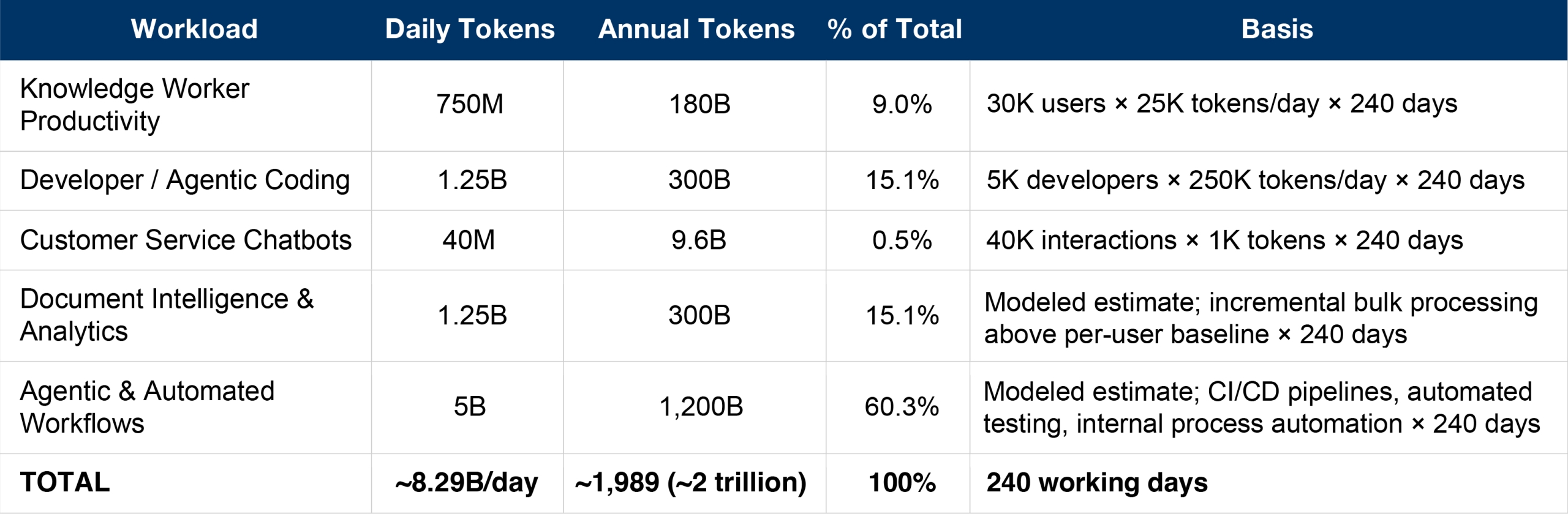
The following analysis uses a Fortune 500 baseline profile with token volume assumptions calibrated to reflect a measured, operationally realistic deployment — not a first-mover or unconstrained rollout. All daily token volumes are set at 50% of raw industry benchmarks to reflect typical enterprise utilization rates, policy constraints, and the reality that not every capability is fully adopted on day one.
Annual Token Volume by Workload
3. Three-Scenarios for Projected Cost
Three pricing scenarios are modelled, reflecting different enterprise model selection and optimization strategies. Scenario prices are blended rates that factor in the 30/70 input/output token split typical of agentic workloads.
Scenario 3: LOW — FinOps-Optimized, Economy Stack
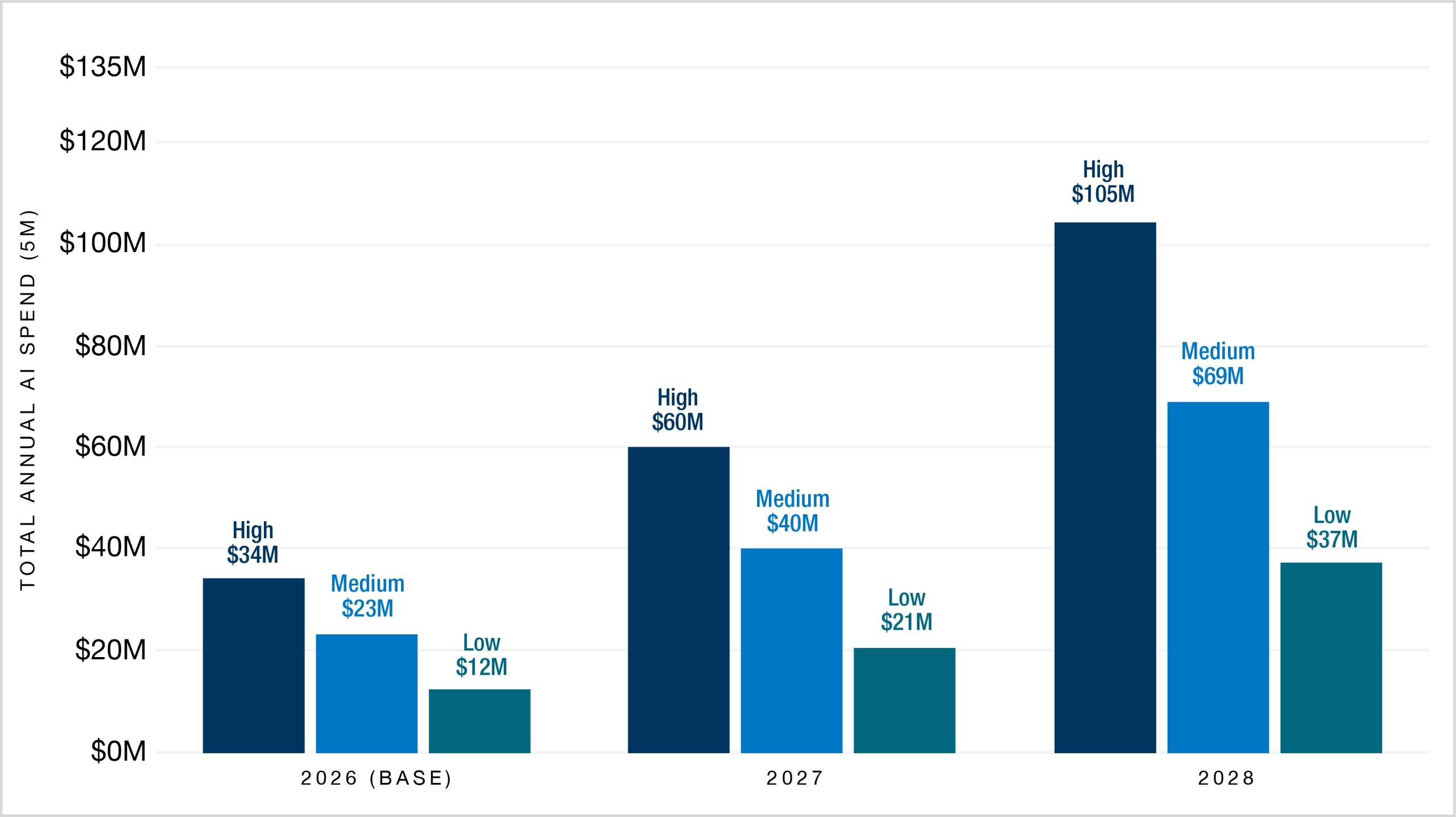
3-Year Cost Trajectory (75% Annual Token Volume Growth)
Token consumption across businesses tracked by Ramp grew 1,001% between January 2025 and April 2026 — equivalent to an annualized growth rate of approximately 780%. For the purposes of this 3-year projection, we apply a deliberately conservative 75% annual volume growth assumption, reflecting moderation as enterprises implement cost controls and FinOps governance.
Even in the optimized Low scenario, the 3-year cumulative spend reaches approximately $70M. In the High scenario, it approaches $200M. CIOs who treat AI as a fixed annual line item will find it structurally underfunded within 12–18 months of any meaningful agentic deployment.
What the Numbers Tell CIOs
The c-suites of major enterprises will need to navigate a much more dynamic AI consumption environment – the consumers are not just tech employees they are all knowledge workers (sales, marketing, HR, finance, customer service).
- The dominant cost is not your workforce — it is your agentic pipelines. Under every scenario, agentic and document intelligence workloads account for more than $75% of total token volume. This is true even with assumptions set at 50% of benchmark utilization. Headcount-based procurement frameworks — seat licenses, per-user cost allocation — are measuring the wrong variable. Knowledge worker productivity, the workload most enterprises track and govern most closely, represents just 9% of total token-consumption. A CIO who tracks AI spend per employee is watching 9% of the cost base and calling it governance.
- The seat fee is the floor, not the ceiling. Across all three scenarios, the seat subscription cost is fixed at $10.9M annually — a number that looks large in isolation but represents between 32% and 89% of total AI spend depending on the scenario. Under frontier model assumptions with no optimization, token consumption is approximately 2.1x the seat cost. That ratio inverts entirely in the Low scenario, where disciplined model routing and caching reduce token spend to the point where seats represent 89% of total cost — reframing the procurement conversation from token governance to seat rationalization. Negotiating a seat price without modelling consumption is optimizing the wrong line item in the High scenario; failing to rationalize seats is the equivalent mistake in the Low.
- Prompt design is a finance function. AI pricing introduces a fundamentally different cost behavior than traditional SaaS: costs scale with usage intensity, not headcount, and usage intensity is driven by agent design decisions made by engineers and data scientists who may have no visibility into the cost implications. Each additional step an AI agent takes to complete a task generates a separate token charge, and the agent decides how many steps to take. Over-broad task specifications, missing stopping criteria, and absent budget guardrails are financial risks masquerading as engineering problems. In a token-metered world, prompt design is a finance function as much as it is a technical one.
- Price competition is real and should be exploited. LLM API prices fell approximately 80% between early 2025 and early 2026. OpenAI has publicly acknowledged AI costs as a serious issue for enterprise clients and signaled further pricing action. Anthropic’s move from bundled per-seat enterprise contracts to a hybrid access-plus-consumption model has lowered the barrier to entry while shifting cost exposure to token consumption. Enterprises with consolidated spend data, clear consumption baselines, and multi-year commitment capacity have genuine negotiating leverage right now — a window that may narrow once IPO lock-ups stabilize competitive dynamics.
- FinOps for AI is not optional anymore. The same disciplines built for cloud cost management — tagging, showback, chargeback, rightsizing, reserved capacity — apply directly to AI token spend. Prompt caching alone, at a 90% discount on repeated context can halve costs for structured enterprise workflows. Batch API, at a 50% discount on non-real-time tasks, offers equivalent savings for document processing pipelines. Enterprises using intelligent model routing — reserving frontier models for complex reasoning and routing routine tasks to economy tiers — typically cut costs 60–80% without quality impact. The governance gap is already showing up in budgets. Zylo’s 2026 SaaS Management Index, found AI-native application spend of $1.2M, up 108% from 2025, with 78% of IT leaders reporting unexpected charges tied to consumption-based or AI pricing models. The surprises are predictable — they follow directly from inadequate governance applied to a cost structure that no longer behaves like traditional software.
5. Recommended CIO Actions (90-Day Horizon)
1. Establish a token consumption baseline. Instrument all AI tooling (Claude, ChatGPT, Copilot, Azure OpenAI) to report token usage by workload, team, and model. Most enterprises currently lack this visibility. It is the prerequisite for every other action on this list, and the single most important input to any vendor negotiation.
2. Implement budget guardrails before expanding access. Set hard spending caps per pipeline, per team, and per application before granting additional agentic or automated AI access. The cost of an uncapped rollout (illustrated repeatedly in 2025 and 2026) is an annual budget consumed in months.
3. Conduct a model routing audit. Identify automated workflows currently running on frontier models that are candidates for economy-tier migration. At 60% of total token volume, the agentic category is where model selection has the highest financial leverage. Shifting even 30% of agentic volume from frontier to economy-tier models reduces the total annual bill by approximately 13% before any other optimization.
4. Engage vendors on consumption commitments before renewal. Enterprise volume commitments with OpenAI can yield 25-40% below list price. Anthropic has eliminated automatic volume discounts, making pre-committed consumption agreements the primary negotiating lever. Renewals executed at list price in the current competitive environment leave material value on the table. Arrive at the negotiating table with consumption data — buyers without usage visibility negotiate blind.
5. Build a 3-year token consumption model. Apply a realistic annual volume growth assumption as a conservative forward-looking estimate — actual growth rates observed by Ramp between January 2025 and April 2026 significantly exceeded this. Model sensitivity to model mix, cache hit rate, and batch API adoption to understand which levers have the most impact for your specific workload profile.
6. Formalize AI FinOps ownership. Assign explicit ownership of AI token spend governance, separate from, but connected to, cloud FinOps. Monthly reporting on AI cost per workload, per model, and per team should be standard operating procedure by Q3 2026. Quarterly vendor rate reviews should be on the CIO calendar through 2027.
AI consumption is now a core requirement of enterprise technology leadership. While Token size and types will evolve, the shift to token based pricing is permanent, and successful organizations will treat AI as a dynamic, governable utility. With clear visibility, intentional model selection, and mature FinOps practices, CIOs can convert today’s volatility into tomorrow’s competitive advantage; an accelerant to enterprise performance rather than an unpredictable drag on the budget.
Disclaimer: The pricing and cost scenarios presented in this paper are based on publicly available information, market observations, and should be considered directional estimates only. Each company and executive will need to customize the parameters of the model based on their usage patterns and company’s appetite for AI adoption. Furthermore, the nature, size and type of token will also evolve, however, the increased consumption of AI capabilities will continue.