Food & Beverage Market Perspective: Insights to Navigate New Consumer Realities
Back to All Insights
Executive Summary
The economic landscape heading into 2026 remains sluggish, with weak growth and persistent inflation continuing to squeeze household budgets and limit consumers’ spending power. As a result, consumer behavior in the food and beverage sector has changed, becoming more health focused and quality driven, buying fewer items overall but, in some cases, paying higher prices when they believe the product delivers meaningful value.
Industry forecasts indicate that the food and beverage sector will see minimal volume growth in 2026, if any, with any modest sales gains driven primarily by pricing and product mix rather than increased demand. At the same time, supply chain disruptions (e.g., tariffs and geopolitical instability) continue to raise costs, placing additional pressure on margins across the industry.
Given these challenges, food and beverage companies are becoming more targeted, quality driven, and operationally efficient to protect profitability and remain competitive in a tightening market.
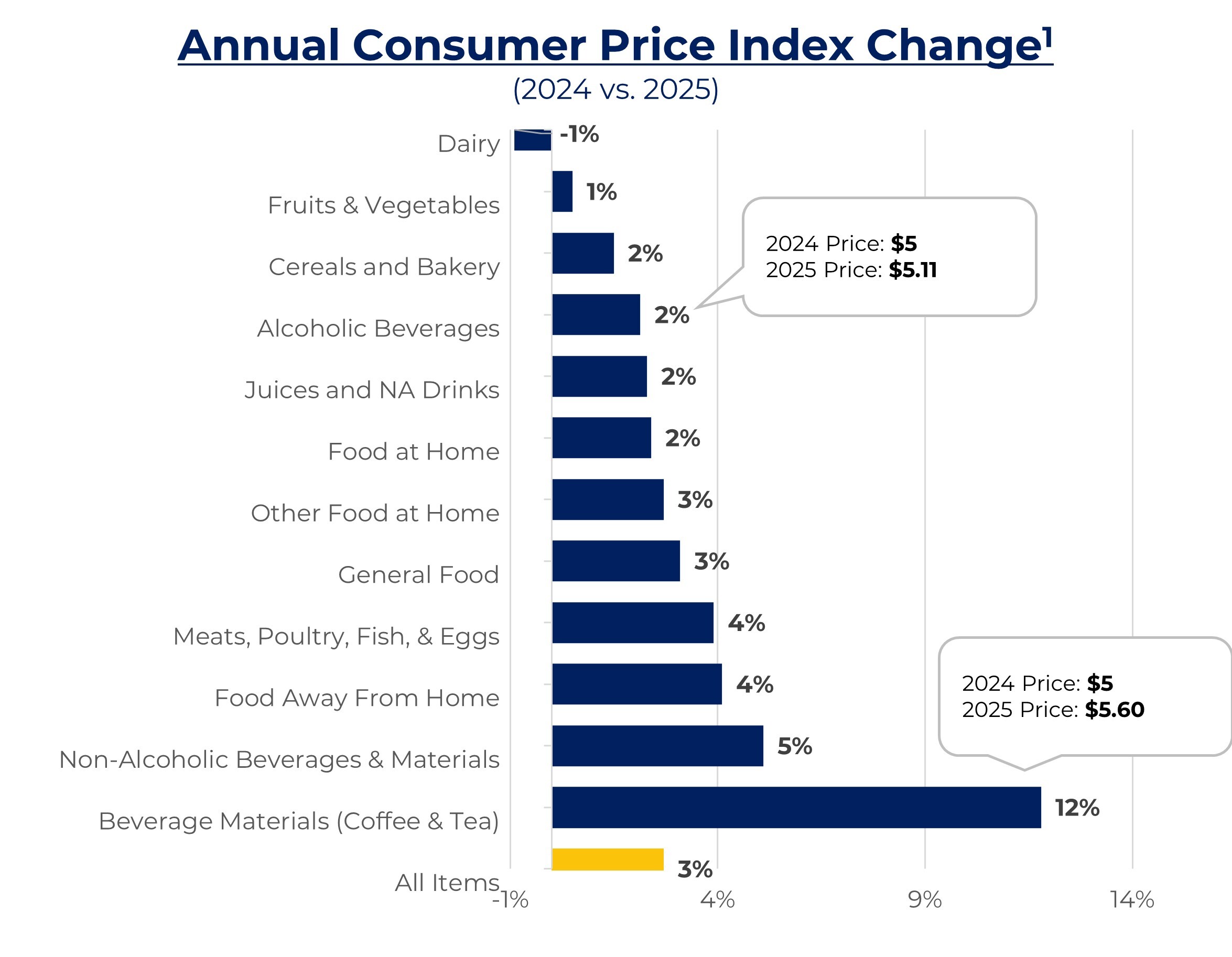
2025 Consumer Price Index shows modest year over year increases in some food and beverage categories
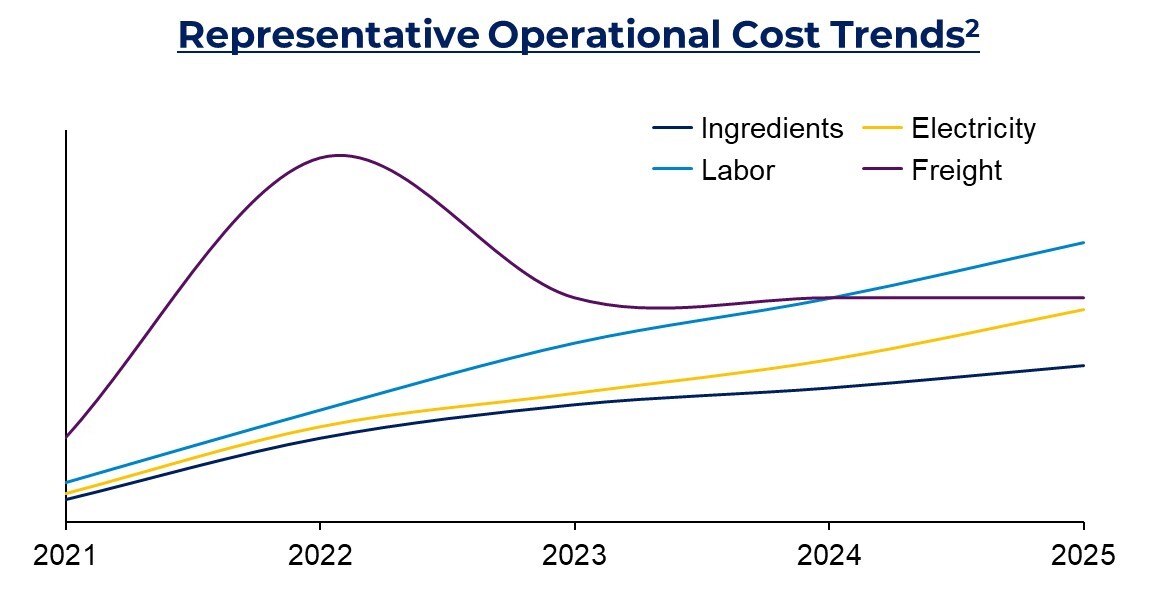
Supply Chain costs are continuing to rise, placing additional pressures on margins across the food and beverage industry
What’s Changing and Why it Matters
Consumer behavior in the food and beverage industry shifted beginning in the late 2010’s with the rise of food-delivery apps, which heightened expectations of convenience and reshaped dining habits. To compete with these platforms, grocery stores added various ready-to-eat meal offerings over the past decade. These ready-to-eat offerings drive significant margin for grocers, and consumers perceive these offerings as healthier and more convenient alternatives. As the pandemic accelerated these preferences, the post-pandemic years saw younger generations driving demand for healthier, more nutrient dense foods – a shift towards wellness and functional choices. This health consciousness also contributed to the noticeable decline in alcohol consumption among younger consumers. In Alvarez & Marsal’s Fall 2025 Consumer Sentiment Survey, nearly half of respondents (48%) reported that they are either abstaining from alcohol entirely or planning to reduce their consumption over the next six months.
More recently, the introduction of GLP-1 medications exacerbated the wellness trend, further pushing consumer choices that emphasize health and functionality.
Against these consumer changes, and amid the sluggish economy, consumers are prioritizing high-quality, health-focused products. While overall volume growth remains flat, consumers are increasingly willing to pay a premium for items that deliver strong taste or functional benefits; 56% of survey respondents say “good value” is defined by great taste4.
Macro-economic headwinds have not only affected consumers, but companies as well. Food & beverage brands are incurring structural changes to their cost structures. Since 2021, freight costs, labor costs, and some direct material costs (i.e., ingredients) have increased more than 20%.
To offset these pressures, companies are passing costs to consumers. According to a recent report5, 95% of producers and manufacturers are passing costs to consumers. How long can this continue?
With pricing locked, demand stagnant, and costs surging, Food and Beverage players must double down on performance improvement to win.
In The News: What Food and Beverage Companies Are Doing
Food and beverage companies are responding to these consumer trends. Some companies are trying to increase top-line growth inorganically (i.e., M&A), some are innovating, and others are prioritizing operational differentiators as margins are squeezed.
These strategies are playing out daily and here are three recent examples:
Mars Acquisition of Kellanova
Mars completed its $35.9B acquisition of Kellanova in December 2025, significantly expanding its footprint in snacking and global packaged goods. The transaction expands Mars’ brand portfolio and positions them firmly within key high-growth snack categories. This acquisition allows Mars to capture major supply chain procurement, and network efficiencies for greater distribution reach as well. With increasing activity in the F&B M&A world, Mars is well positioned to capture scale advantages along with cross-category leverage
Mondelez International’s $1.2B ERP & Supply Chain Transformation
Mondelez is midway through a four-year, $1.2B ERP and supply chain transformation initiative designed to modernize their enterprise systems. This investment is focused on improving demand planning accuracy, procurement visibility, and end-to-end operational efficiency. By consolidating legacy systems into an integrated digital backbone, Mondelez expects to drive reduced distribution spending and optimized working capital. This investment highlights the industry-wide push towards modernized, data-driven supply chain networks of the future.
Albertson’s Investment in Automation
Albertson’s focus is to increase efficiency within their distribution centers. By accelerating automation, they aim to increase throughput and reduce manual labor dependency. This strategy supports a more resilient and advantageous cost structure amid tight labor markets.
What You Can Do: Recommendations for 2026 and Beyond
Conclusion
The food and beverage industry is facing stalled growth, rising costs, and growing margin pressure across the value chain. Companies that act now – by accelerating commercial performance, optimizing cost structures, and modernizing operations – will be best positioned to outperform in this challenging environment.
At A&M, we have partnered with numerous food and beverage companies to deliver enterprise-wide transformations that drive top-line growth and margin stabilization. If transformation is on your agenda, or if you are finding it difficult to keep pace with industry headwinds, we’d welcome the conversation about how we can support your goals.
By Sooho Choi, Pat Cueller, Chad Lusk, Jim Pfeiffer, John Temple